¿Hola qué tal? – PsyErgo auf der CHI 2026 in Barcelona
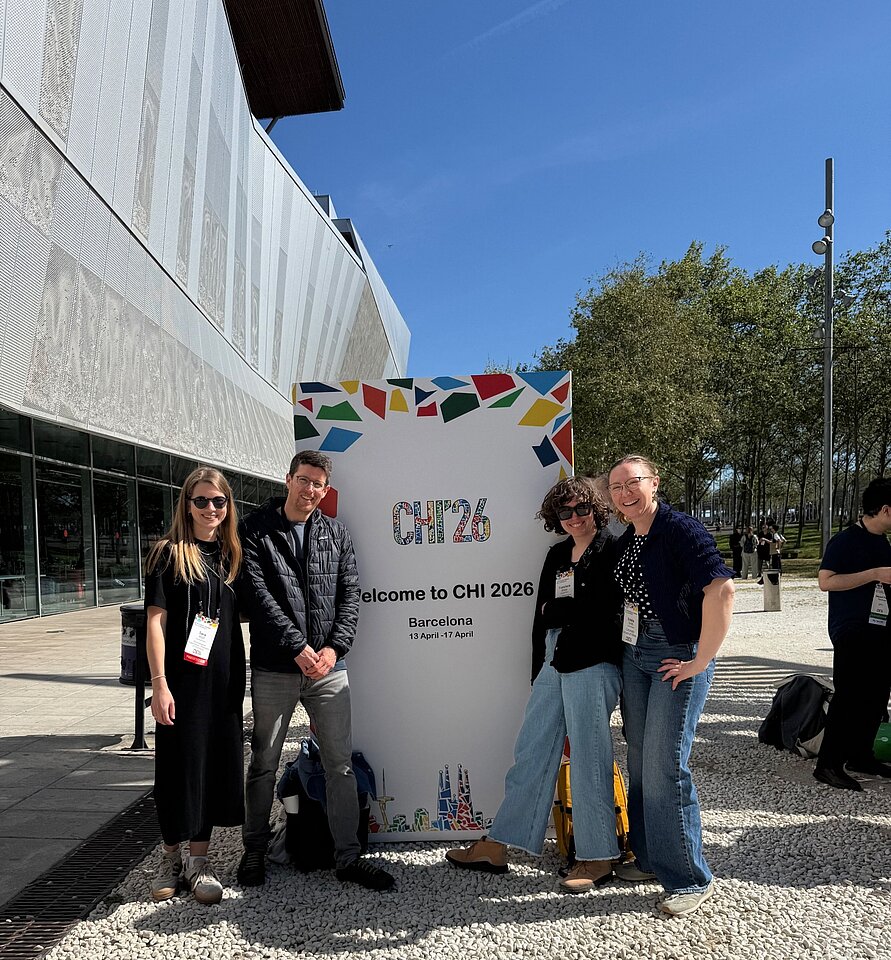
06.05.2026Auf der ACM CHI Conference on Human Factors in Computing Systems 2026 trafen sich mehr als 5000 Forscher:innen aus dem Bereich der Human-Computer-Interaktion, um aktuelle Themen der HCI zu diskutieren. Die CHI bietet jährlich eine Plattform für den interdisziplinären Austausch über neue technologische Entwicklungen, nutzerzentriertes Design und psychologische Grundlagen der Interaktion mit digitalen Systemen. Die diesjährige Veranstaltung fand vom 13.04. bis 17.04. in Barcelona statt. Im Rahmen der Konferenz präsentierten und diskutierten Sara Wolf, Franzisca Maas und Tobias Grundgeiger in vier Vorträgen und einem Workshop aktuelle Forschungsarbeiten der PsyErgo, von denen eine als Honorable Mention ausgezeichnet wurde.
Beiträge und Zusammenfassungen:
Ambe, A. H., Salisbury, I., Grundgeiger, T., Bodnar, D., Rothwell, S., Brown, N., & Matthews, B. (2026). Out of Emergency: How Doctors Navigate Jurisdictional Seams in Emergency Care Referrals. CHI Conference on Human Factors in Computing Systems (CHI'26), Barcelona, Spain.
https://doi.org/10.1145/3772318.3791645 (Honorable Mention)
Handover is one of the most studied elements of clinical care and its importance to the good continuity of care and patient outcomes is well- accepted. Unfortunately, efforts to improve the quality of clinical handovers have led to an environment of compliance exemplified by mnemonics, templates and audits that assume or suggest handovers to be stable, reproducible processes that can be judged by conformity to checklists. However, handovers are highly heterogenous, personalised and nuanced events that do not easily fit into tightly structured models. We draw on observational work in a 2- year, ongoing collaboration between a large emergency department and a human- centred design research team, and argue that handover is essentially a craft: a skilled practice shaped by timing, uncertainty, recipient needs and jurisdictional boundaries. We suggest that standardisation of handovers can work against quality, and that simple checklists threaten to flatten rather than enhance their true craft or value. Shifting how clinical handover is understood, taught, assessed and supported, by emphasising the importance of craft over completeness may be the secret to ensuring quality.
Bahnsen, K. L., & Grundgeiger, T. (2026, 13 to 18 April 2026). AR-Cues Change Users’ Strategy for Dealing with Deferrable Interruptions. CHI Conference on Human Factors in Computing Systems (CHI'26), Barcelona, Spain. https://doi.org/10.1145/3772318.3790673
When given the opportunity, people tend to try to reach coarse breakpoints for work interruptions. Coarse breakpoints are frequently associated with less effort when resuming the task. We investigated how supporting task resumption with augmented reality (AR)-cues affects this behavior. In a mixed factorial experiment, 50 participants performed a physical sorting task that included deferrable interruptions with varying distances to a coarse breakpoint, either with or without an AR-cue indicating the next correct step after interruption. Participants with AR-cue accepted interruptions at fine breakpoints more frequently than those without a cue, except when the coarse breakpoint was one step away, and reported less stress. Our findings indicate that AR-cues attenuate but do not eliminate the need for specific task resumption strategies, such as reaching a coarse breakpoint, and reduce the stress. Considering AR-cues for task resumption may be particularly beneficial for time-critical interruptions and fast-paced work environments.
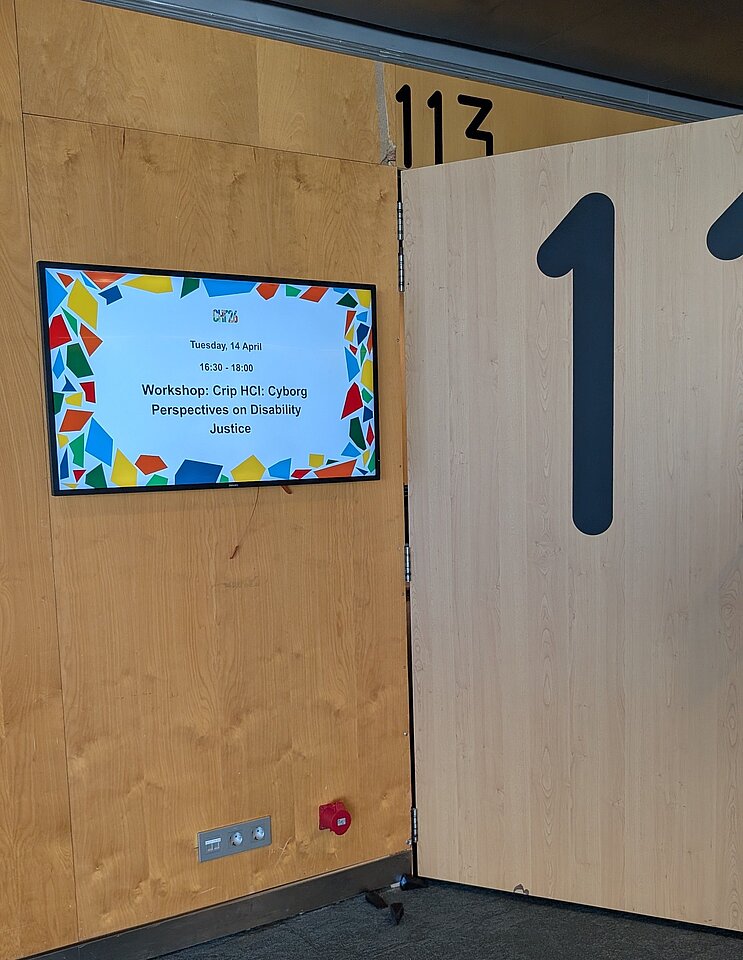
Christoph Becker, Laura Forlano, Beatrice Vincenzi, Franzisca Maas, Alesandra Baca-Vázquez, Casey Fiesler, and Rua Mae Williams. 2026. Crip HCI: Cyborg Perspectives on Disability Justice. In Proceedings of the Extended Abstracts of the 2026 CHI Conference on Human Factors in Computing Systems (CHI EA '26). Association for Computing Machinery, New York, NY, USA, Article 932, 1–7. https://doi.org/10.1145/3772363.3778767
Building on an emerging awareness of disability justice and calls for a crip HCI, this workshop brings together disabled researchers across HCI with an interest in how the politics and design of cyborg technologies relate to the rich, situated, and existential understandings that emerge from living a cyborg life. By centering the perspectives of cyborgs, this workshop de-centers extractive techno-solutionist practices to catalyze research momentum and foster the crip research community in HCI.
Grundgeiger, T., Maurer, L., Hölzing, C. R., & Happel, O. (2026, 13 to 18 April 2026). AI-Supported Electrocardiogram Interpretation: The Effect of Support Presentation on Diagnostic Accuracy, Psychological Need Satisfaction, and Diagnosis Time. CHI Conference on Human Factors in Computing Systems Proceedings (CHI '26), Barcelona, Spain.
https://doi.org/10.1145/3772318.3790619
Interpreting electrocardiograms (ECGs) is an important but complex and error-prone task. While diagnostic support algorithms exist, how support is displayed and how clinicians interact with ECG diagnostic and clinical decision support systems in general remain underexplored. In this preregistered experiment, we studied how providing clinicians with different versions of diagnostic support affects ECG interpretation. All four support types improved diagnosis accuracy compared to a no-support control condition, but the most effective was support offering visual ECG trace markings. User experience, in the form of psychological need satisfaction of competence and security, was highest when clinicians first viewed the ECG independently and then received support in a second stage. The latter two-stage support also resulted in the shortest diagnosis times. We conclude with design and research implications for creating clinician-algorithmic support interactions that improved user experience, efficacy, and effectiveness in the present study, and may ultimately contribute to patient safety.
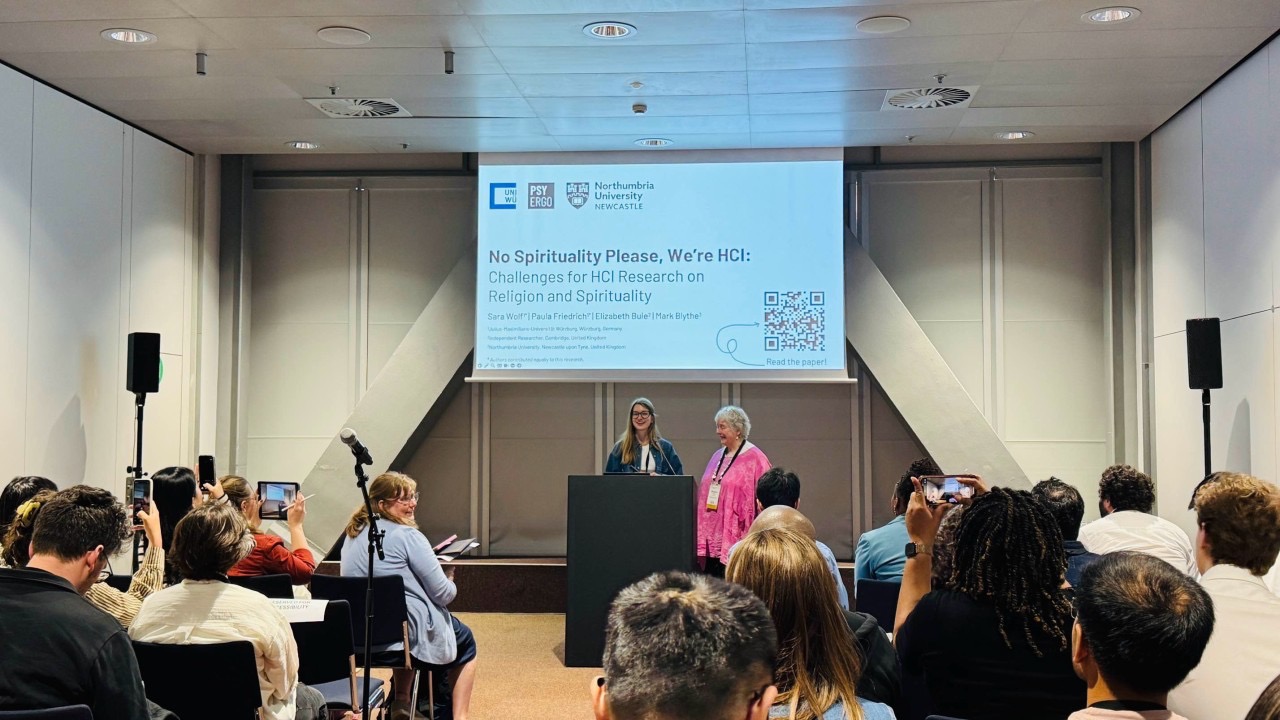
Sara Wolf, Paula Friedrich, Elizabeth Buie, and Mark Blythe. 2026. No Spirituality Please, We’re HCI: Challenges for HCI Research on Religion and Spirituality. In Proceedings of the 2026 CHI Conference on Human Factors in Computing Systems (CHI '26). Association for Computing Machinery, New York, NY, USA, Article 1265, 1–29. https://doi.org/10.1145/3772318.3790490
Religion and spirituality (R/S) shape billions of lives, yet they remain marginal in Human–Computer Interaction (HCI) research. Prior literature reviews mapped fragments of this space but missed key contributions and the lived realities of its researchers. We extend this picture through a review of 206 ACM and IEEE publications and a survey of R/S scholars in HCI (n = 19). Our analysis shows a field in transition: Research on R/S is growing slightly in volume and diversity, with design-oriented work emerging as the dominant form of engagement. Yet the ACM and IEEE corpora remain largely separate, reflecting distinct epistemic traditions. Researchers report persistent challenges, including marginalization, exposing a deeper tension in HCI: While HCI claims to center the full range of human experience, R/S experience is still treated with suspicion. Our findings call for a reconsideration: If HCI is serious about human experience, it must take R/S experiences seriously as well.
Weitere Bilder