Neues Paper zu Participatory Contextual Design erschienen
03/09/2026Franzisca Maas (PsyErgo) hat gemeinsam mit Sara Wolf (PsyErgo), Marie Fiedler (PIIS), Michael Weber (ehem. PsyErgo), Jörn Hurtienne (PsyErgo) und Arne Berger (HS Anhalt) ein neues Paper in der Zeitschrift International Journal of Human-Computer Interaction veröffentlicht.
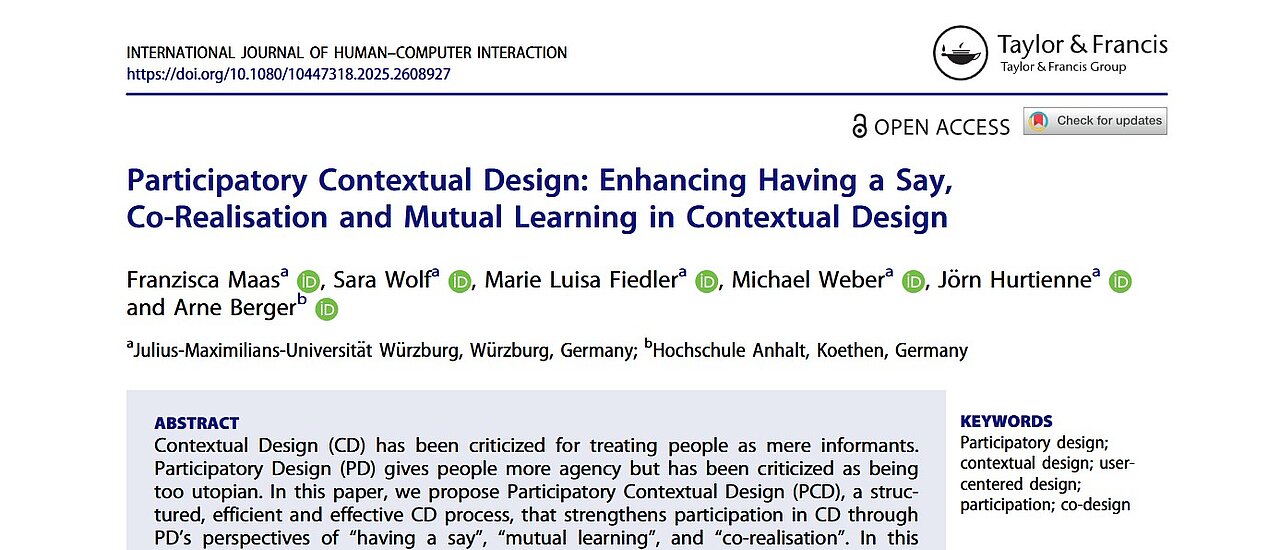
Der Artikel zeigt, wie der menschzentrierte Designprozess des Contextual Design mithilfe von Partizipativem Design erweitert werden kann, sodass Nutzende nicht nur Informant*innen im Designprozess sind, sondern als Co-Designende im ganzen Prozess partizipieren können. Der Artikel beschreibt die Methode des Participatory Contextual Design detailliert anhand des Bürgerbeteiligungsprojekts am Hubland (ForDemocracy 2018-2022, hubbel) und kann auch genutzt werden, um Anregungen zu generieren wie andere Designprozesse partizipativer gestaltet werden können.
Das Paper ist Open Access verfügbar:
Maas, F., Wolf, S., Fiedler, M. L., Weber, M., Hurtienne, J., & Berger, A. (2026). Participatory Contextual Design: Enhancing Having a Say, Co-Realisation and Mutual Learning in Contextual Design. International Journal of Human–Computer Interaction, 1–26. https://doi.org/10.1080/10447318.2025.2608927
Abstract:
Contextual Design (CD) has been criticized for treating people as mere informants. Participatory Design (PD) gives people more agency but has been criticized as being too utopian. In this paper, we propose Participatory Contextual Design (PCD), a structured, efficient and effective CD process, that strengthens participation in CD through PD’s perspectives of “having a say”, “mutual learning”, and “co-realisation”. In this paper, we (1) contribute a framework of how PCD can be realized in practice, (2) illustrate and reflect this at the example of two iterations in a civic participation project, (3) provide guidelines for applying and adapting PCD in other projects, and (4) provide empirical evidence that PCD increases participation in CD and aligns PD perspectives toward delivering a working product. Overall, PCD provides a way of scaling PD in contexts where participation is still rare and thus contributes to designing better technology for and with those who are affected.